
If your NYC home feels drafty, cold in winter, or your heating and cooling bills are climbing, a blower door test is the diagnostic tool you need. This guide explains what a blower door test is, how it works, what the results mean, and how NYC homeowners can access testing at no cost through the EmPower+ program.
NYC Homeowners May Qualify for Blower Door Testing at No Cost
Through the EmPower+ program, income-eligible NYC homeowners can get blower door testing and energy upgrades covered at no cost.
What Is a Blower Door Test?
A blower door test is a diagnostic procedure that measures how much air is leaking in and out of your home through cracks, gaps, and other openings in the building envelope. It is the gold standard for identifying air infiltration in residential buildings and is used by energy auditors, contractors, and building scientists throughout NYC.
The test uses specialized equipment that creates a controlled pressure difference between the inside and outside of your home, allowing technicians to precisely measure the rate of air leakage. Unlike DIY methods (like holding a candle near suspect areas), professional blower door testing provides objective, numerical data that you can use to prioritize weatherization improvements.
In NYC, where many homes were built before modern insulation and air sealing standards existed, blower door testing is particularly valuable. Pre-war apartment buildings, brownstones, and row houses are notorious for air leakage. A blower door test can reveal exactly where you are losing money to wasted energy every heating and cooling season.
Why You Need a Blower Door Test in NYC
The NYC Building Challenge
New York City's housing stock is unique. Many of our buildings are 80, 100, or even 150+ years old. When they were built, energy efficiency was not a priority. Walls were constructed without cavity insulation, windows were single-pane or double-pane at best, and air sealing was nonexistent.
The result? Older NYC homes typically have very high air leakage rates compared to modern construction. If you live in a pre-war building, brownstone, or older row house in Brooklyn, Manhattan, Queens, the Bronx, or Staten Island, you are almost certainly losing significant amounts of conditioned air.
A blower door test quantifies this problem. Instead of guessing, you will have hard data showing exactly how much air is leaking and where it is happening.
Energy Savings and Comfort Benefits
When you identify and seal air leaks, you will see immediate benefits:
- Lower heating and cooling costs. Sealing air leaks can reduce your HVAC energy use by 15-30%, potentially saving hundreds of dollars per year
- Improved comfort. Fewer drafts and more consistent indoor temperatures
- Better indoor air quality. Controlled ventilation means fresh air when you need it, without uncontrolled drafts bringing in dust and outdoor air pollution
- Reduced moisture problems. Uncontrolled air leaks can introduce humidity in summer and cause condensation in winter, leading to mold and structural damage
- Increased home value. Energy-efficient homes are more attractive to buyers and appraisers
NYC Incentive Alert: Through the EmPower+ program, income-qualified NYC homeowners can get a blower door test, air sealing, and energy upgrades at no cost. Check the income requirements for your borough.
How Does a Blower Door Test Work? Step-by-Step
Before the Test Begins
Our technicians arrive with a blower door unit, diagnostic tools, and moisture meters. Before beginning, we will:
- Close all windows and doors (except the one where the blower door unit is installed)
- Close fireplace dampers to prevent outside air from entering
- Turn off exhaust fans, kitchen ventilation, and clothes dryers
- Seal any intentional openings (like pet doors) temporarily
Setting Up the Blower Door Unit
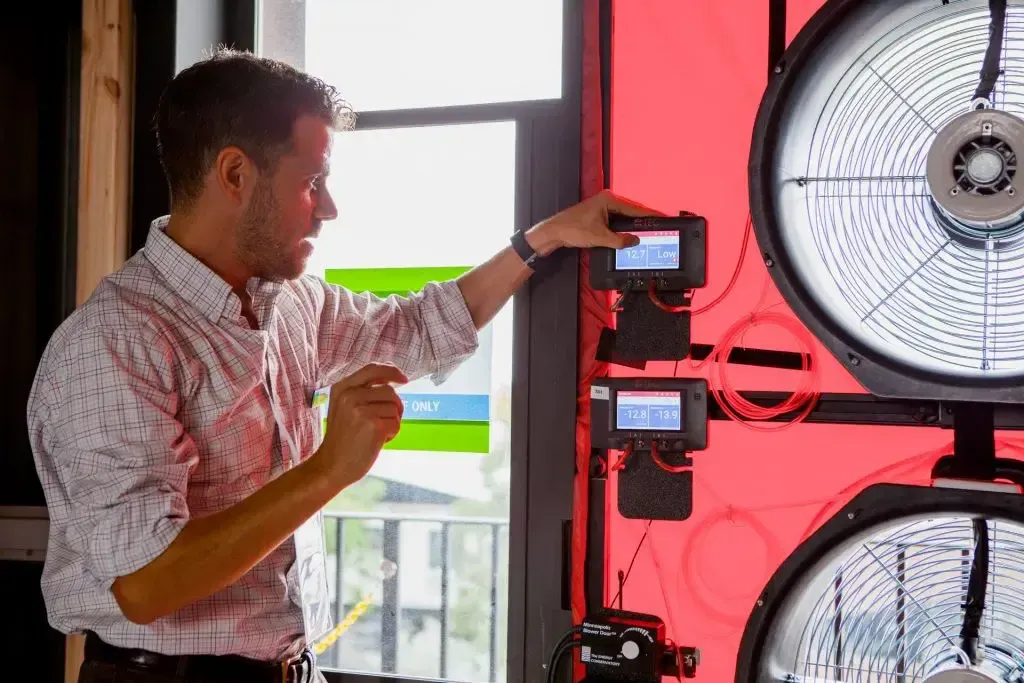
The blower door unit consists of a powerful variable-speed fan mounted in a frame that fits into a doorway (typically the main entry door). The frame is sealed around the edges to create an airtight seal. The fan can push air out of or pull air into your home at controlled speeds.
The unit is connected to electronic equipment that measures air pressure, temperature, and flow rate. Modern blower door systems are connected to diagnostic software that records data continuously throughout the test.
Depressurization Phase
The blower door fan runs at increasing speeds to depressurize (reduce the air pressure inside) your home. As the interior pressure drops, outdoor air naturally flows in to equalize the pressure difference through every crack, gap, and opening in your walls, doors, windows, and roof.
The technician gradually increases the fan speed until the interior pressure reaches 50 Pascals below outdoor pressure. At this point, the software calculates the air leakage rate and converts it into ACH (Air Changes Per Hour).
Pressurization Phase
The test repeats in reverse. The fan now pressurizes (increases the interior air pressure) your home to 50 Pascals above outdoor pressure. This pushes air out through all the same leaks. The result should match the depressurization phase if the test was conducted correctly.
This two-phase approach provides confirmation of the results and helps identify any anomalies.
Thermal Imaging (Optional but Recommended)
Many professional energy audits, including those performed through the EmPower+ program, include thermal imaging. While the blower door is running and depressurizing your home, our technician uses an infrared camera to identify where air is leaking.
Cold outdoor air flowing in during winter shows up as dark areas on the thermal camera. This visual evidence helps technicians prioritize which leaks to seal first and can pinpoint problems that are not always obvious, like air leaking into wall cavities or around hidden structural elements.
Post-Test Walkthrough
After collecting the numerical data, we walk through your home with you to identify visible air leaks, including:
- Gaps around baseboards and trim
- Openings around electrical outlets, light switches, and penetrations
- Air leaks around windows and doors
- Gaps where different materials meet
- Attic bypasses (common in older NYC homes, where heated air rises into attics)
Understanding Your Blower Door Test Results: ACH Explained
What Is ACH?
ACH stands for "Air Changes Per Hour." It measures how many times per hour all the air in your home is replaced by outside air, assuming the same pressure difference that existed during the test (50 Pa).
For example, if your home has an ACH of 10, that means all the air in your house would be replaced 10 times in a single hour under the test conditions. A lower ACH number means fewer air leaks and better energy efficiency.
What Is a "Good" ACH Score for NYC Homes?
The interpretation depends on your home's age and type:
| Building Type | Typical ACH |
|---|---|
| Pre-war buildings (before 1970) | 10-20+ ACH |
| 1970s-1990s homes | 7-12 ACH |
| Post-2000 standard construction | 4-7 ACH |
| Energy-efficient new homes | 2-4 ACH |
| High-performance homes | Less than 2 ACH |
Important context for NYC: If you live in a Manhattan pre-war apartment, a Brooklyn brownstone, or a Queens row house, an ACH of 12-15 does not necessarily mean something is "wrong" with your home. It means your home has characteristics typical of its age and type. The goal is to improve it over time through strategic air sealing and weatherization.
The 50 Pa Standard: The 50 Pascals pressure difference used in blower door testing is an industry standard. It is a controlled lab condition that allows comparison between homes. Normal differences between indoor and outdoor pressure are typically much smaller (under 5 Pa). Air leakage happens at all pressure differences, not just at the exaggerated test conditions.
Other Important Results to Understand
CFM50: This is the amount of air (in cubic feet per minute) leaking at the 50 Pa pressure difference. A technician might tell you "Your home has 3,000 CFM50 at 50 Pascals." This is another way of expressing the same leakage data as ACH.
Effective Leakage Area (ELA): Some reports express leakage as a total area of holes. For example, "Your home's air leakage is equivalent to a 15-square-inch hole." This helps visualize the problem.
Professional Blower Door Test vs DIY Air Leak Detection
You may have heard about DIY methods for finding air leaks. Here is how professional testing compares:
| Factor | Professional Blower Door Test | DIY Methods (Candle, Incense) |
|---|---|---|
| Measurement Type | Precise numerical data (ACH, CFM50) | Visual observation only |
| Detects All Leaks | Yes, including hidden leaks in walls | Only finds obvious, drafty areas |
| Reveals Attic Bypasses | Yes, identifies where heated air escapes | Difficult to find without entering attic |
| Quantifies Severity | Shows exactly how much air is leaking | Only shows "something is drafty here" |
| Before/After Verification | Test again after sealing to verify improvement | Cannot reliably measure improvement |
| Cost | $200-$500 (often covered through EmPower+) | $0-$50 for DIY materials |
| NYC Building Compatibility | Designed for all building types and ages | Most effective in newer, simpler homes |
Bottom line: DIY air leak detection has a place (finding obvious drafts), but professional blower door testing is the only way to get a complete picture of your home's air tightness and make informed decisions about improvements. Ready to get started? Schedule your blower door test.
When Do You Need a Blower Door Test?
Mandatory Situations
Energy audit before weatherization: If you are planning to do air sealing, insulation upgrades, or other energy improvements, start with a blower door test. This gives you baseline data and guides which improvements will have the most impact.
NYSERDA EmPower+ Program: If you are income-qualified in NYC, NYSERDA provides comprehensive energy audits that include blower door testing at no cost.
New construction or major renovations: Building codes increasingly require blower door testing to verify that new construction meets energy code requirements.
Building science investigations: If you are experiencing unexplained condensation, mold, moisture issues, or uncomfortable temperature variations, a blower door test often reveals the root cause.
Strategic Situations
Before and after weatherization: Test before sealing air leaks, then test again after to document improvements. This provides objective evidence of your contractor's work quality.
Home inspection during purchase: Savvy NYC homebuyers sometimes include blower door testing in their inspection. It reveals how much you will spend on heating and cooling.
Periodic audits of older buildings: For pre-war apartments and older row houses, periodic testing every 5-10 years can track changes in your building's condition.
Blower Door Testing Costs in NYC
A standalone blower door test in NYC typically costs $250-$500, depending on:
- Size of the home
- Whether the test is combined with a full energy audit
- Whether thermal imaging is included
- Complexity of your building envelope
However, if you qualify for EmPower+, the cost is covered. NYSERDA covers the full cost of a comprehensive home energy assessment, which includes blower door testing, for income-eligible homeowners. After testing reveals your building's inefficiencies, you can access energy upgrades (air sealing, insulation, heating system improvements) at no cost to you.
The EmPower+ Advantage for NYC Homeowners
As a participating contractor in the EmPower+ program, we help NYC homeowners access this resource:
- Blower door testing at no cost. The diagnostic phase is fully covered
- Air sealing and weatherization covered. NYSERDA covers the cost of sealing the leaks we identify
- Income-based eligibility. Most working and middle-class NYC homeowners qualify. Check your borough's income limits
- Additional upgrades available. Depending on what the assessment finds, you may qualify for insulation, heating system, and window improvements at no cost
Qualify for Blower Door Testing at No Cost Through EmPower+
As a participating contractor in the EmPower+ program, we help NYC homeowners access testing and upgrades at no cost. Check if you qualify today.
What Happens After Your Blower Door Test?
You Will Receive a Detailed Report
After testing, you will get a comprehensive report that includes:
- Your home's ACH and CFM50 measurements
- A detailed list of air leaks identified during visual inspection
- Thermal images showing where heat is escaping (if thermal imaging was included)
- Recommendations for prioritized improvements, ranked by potential impact
- Estimated energy savings from implementing the recommendations
Air Sealing (The First Priority Improvement)
The most cost-effective improvement after blower door testing is usually air sealing. Our technicians use:
- Caulk and sealant for gaps around trim, baseboards, and non-moving joints
- Weatherstripping for moving parts like window and door frames
- Spray foam for larger gaps and cavities
- Attic bypass sealing to close the gap where heated indoor air leaks into the attic
- Duct sealing to close leaks in HVAC ductwork
Air sealing typically costs $500-$2,000 for a full home treatment, though EmPower+ covers much of this cost for qualified homeowners. After sealing, we can perform a follow-up blower door test to verify that your improvements achieved the expected results.
Next Steps: Insulation and Heating System Upgrades
After addressing air sealing, the next priorities typically involve:
- Attic insulation. Adding or upgrading insulation in unfinished attics
- Wall cavity insulation. Blown-in cellulose or fiberglass can be added to existing wall cavities
- Heating system replacement. Upgrading old, inefficient boilers or furnaces to high-efficiency models
NYC Building Types and Blower Door Testing Considerations
Pre-War Apartments (Manhattan, Brooklyn)
Pre-war buildings are drafty for a reason: they were built with plaster and lath walls (no insulation), single-pane windows (often partially painted shut), and no air sealing. Typical ACH readings are 12-20. Air sealing improvements focus on caulking around windows and doors, sealing attic bypasses, and identifying hidden gaps where walls meet the building structure.
Brownstones (Brooklyn, Manhattan)
Brownstones present unique challenges: they often have multiple stories, basement windows, exterior iron storefronts, and masonry that moves seasonally. Blower door testing helps identify where air is leaking through the masonry, around iron elements, and where basement and upper-floor air handling differs. Many brownstone owners are surprised to find that lower floors have dramatically different leakage than upper floors.
Row Houses and Townhouses (All Boroughs)
Row houses tend to be very drafty at party walls (shared walls with neighbors) and around attic access points. Blower door testing often reveals large leaks between your home and your neighbor's space, usually in the attic. Attic bypass sealing is typically the highest-impact improvement for row houses.
Older Single-Family Homes (Queens, Outer Boroughs)
Older homes in Queens, the Bronx, and Staten Island often have unfinished basements with many penetrations (where plumbing, electrical, and HVAC pass through the rim joist and band board). These rim board leaks are a huge source of air infiltration. Blower door testing identifies these problem areas for targeted air sealing and rim board insulation improvements.
Common Questions About Blower Door Testing
Is a blower door test safe for my home?
Yes, absolutely. The blower door creates a temporary pressure difference that is well within normal building tolerances. Your home naturally experiences pressure differences much larger than the test conditions during storms and temperature changes. The equipment is designed and tested for safety. No permanent changes are made to your home during the test.
How long does a blower door test take?
A standalone blower door test typically takes 1-2 hours, including setup, testing, and a walkthrough identifying visible air leaks. If combined with a full energy audit (as in the EmPower+ program), plan for 2-4 hours. The technician will explain what we are finding as we go.
Will a blower door test damage anything in my home?
No. The blower door unit is mounted in a doorway with a removable frame and airtight seal. It is designed to be reversible and non-invasive. The only preparation required is closing windows and doors. Thermal imaging, if used, is completely non-contact.
Will my electric bill increase because of the blower door test?
No. The test takes only an hour or two and uses minimal electricity. The blower door fan is much smaller than your HVAC system. Your electric bill will not be affected at all.
What is the difference between CFM and CFM50?
CFM stands for cubic feet per minute. CFM50 specifically refers to the air leakage measured at 50 Pascals pressure difference during the blower door test. It is the same data as ACH, just expressed in different units. Your blower door test report will likely use both ACH and CFM50.
Can I do a blower door test on a rental apartment in NYC?
Yes, but you will need your landlord's permission. The test is completely non-destructive, and many landlords appreciate the diagnostic information. If your building participates in EmPower+ (and many NYC multi-family buildings do), the test may be covered at no cost. Contact us to discuss your specific rental situation.
How often should I test my home?
For most homes, once every 5-10 years is reasonable. Test before major air sealing or weatherization work to establish a baseline, then test again after the work to verify improvements. If you are experiencing new problems (unexplained drafts, moisture, temperature inconsistencies), test immediately to diagnose the cause.
Why Choose NY Energy Project for Your Blower Door Test?
We have completed thousands of blower door tests across all five boroughs. Our expertise in NYC's unique building stock (pre-war apartments, brownstones, row houses, and older single-family homes) means we understand your home's specific challenges.
As a participating contractor in the EmPower+ program, we help homeowners access testing and upgrades at no cost. We are familiar with NYSERDA requirements, building science best practices, and the specific energy efficiency challenges that NYC homeowners face.
Our 39 five-star Google reviews reflect our commitment to thorough, professional service. We do not cut corners on testing, and we take the time to explain your results clearly.
We serve all of NYC: Manhattan, Brooklyn, Queens, the Bronx, and Staten Island.
Take the First Step Toward Energy Efficiency
A blower door test is the foundation of smart energy improvement decisions. Instead of guessing where you are losing money to wasted heating and cooling energy, you will have professional data that guides your spending and maximizes your return on investment.
For NYC homeowners, the opportunity is even better: if you qualify for EmPower+, blower door testing and air sealing improvements are covered at no cost. There is no better time to take action.
Learn more about the EmPower+ program, check your income eligibility, read our EmPower+ FAQ, or find out if EmPower+ is legit.
Related Articles
- EmPower+ Program NYC: No-Cost Home Energy Upgrades
- Home Energy Audit in NYC: What It Covers and How to Get One
- Is EmPower+ Legit? What NYC Homeowners Need to Know
- EmPower+ FAQ: Every Question NYC Homeowners Ask, Answered
- Cellulose vs Fiberglass Insulation: Which Is Best for NYC Homes?
Ready to Diagnose Your Home's Air Leaks?
NY Energy Project provides professional blower door testing across all five NYC boroughs. We also help qualified homeowners access the EmPower+ program for no-cost testing and upgrades.
